Panchang
Chandrika
Offline • Hindi & English • Free
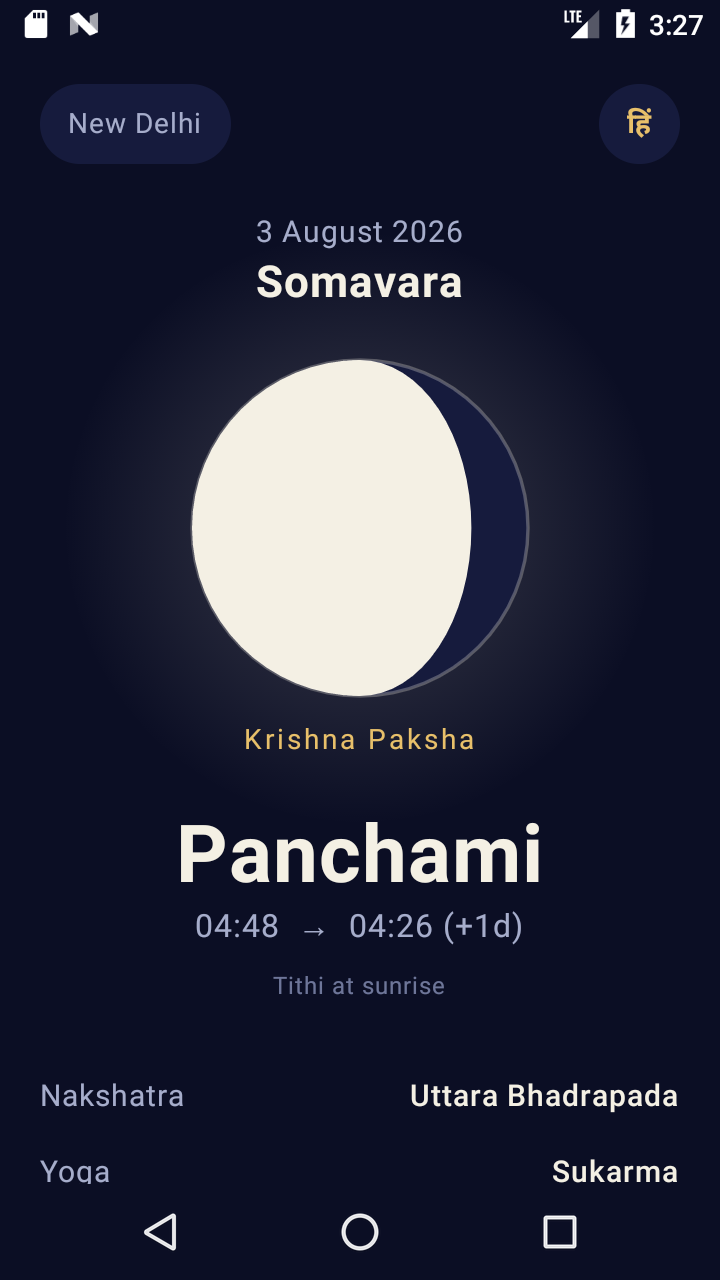
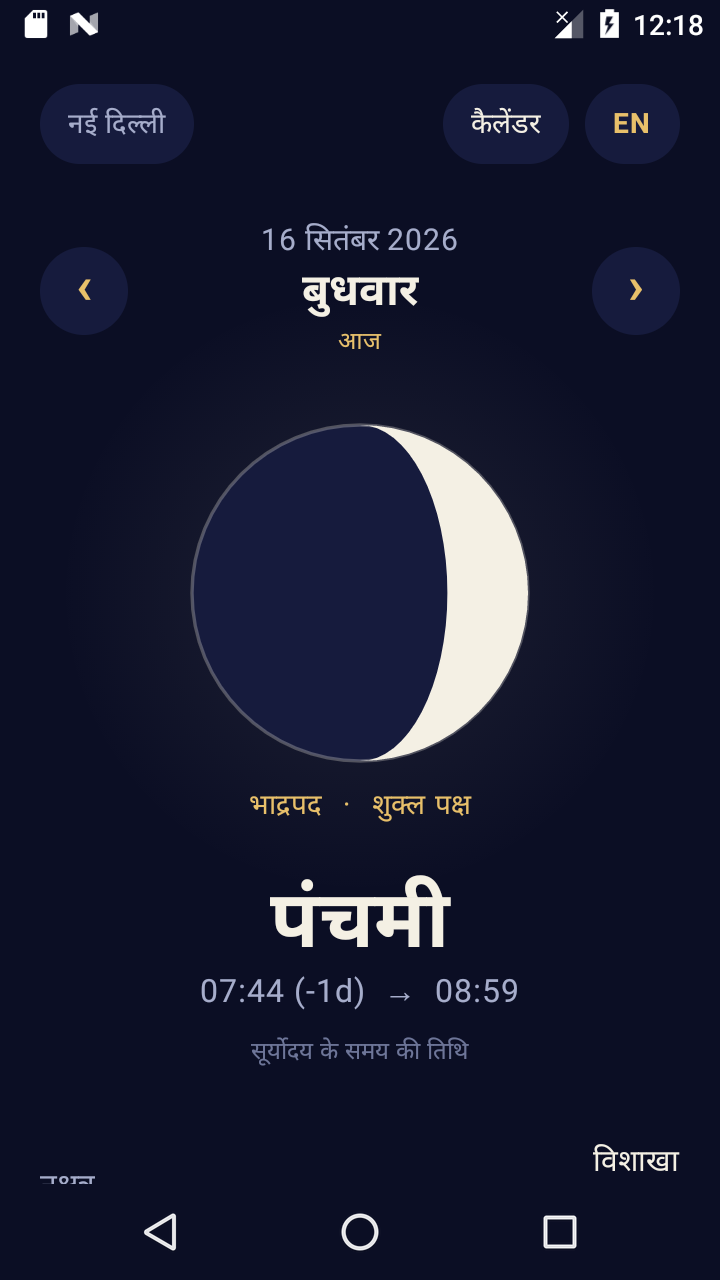
A quiet, offline Hindu panchang and calendar. Open it and the day's tithi is the first thing you see — with the time it began and the time it ends, not just its name. Step to any date, read the month as a grid, and see the festivals and vrats coming up.
Every reading is calculated on your device from the position of the Sun and the Moon — no account and no sign-up, and nothing you see is fetched from a server. The panchang itself works in aeroplane mode, in a temple basement, on a train with no signal.
Screenshots
What's inside
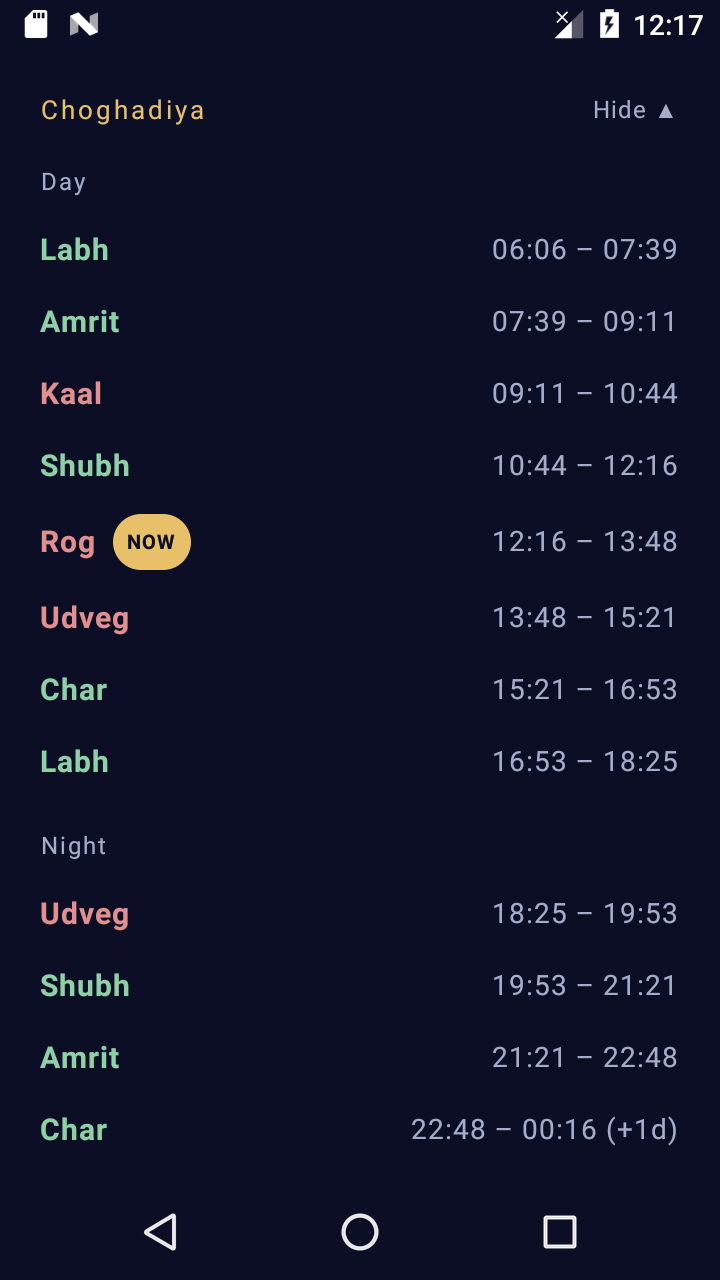
All sixteen choghadiya, day and night
Eight periods from sunrise to sunset and eight more from sunset to the next sunrise — each named (Amrit, Shubh, Labh, Char, Udveg, Kaal, Rog) and marked auspicious or not, with the one running right now highlighted. Every slot is derived from your own city's sunrise and sunset, which is why it is never the clock time printed in a newspaper table. Alongside it: Rahu Kaal, Yamaganda, Gulika Kaal and Abhijit Muhurat, on one card at the top of the screen.
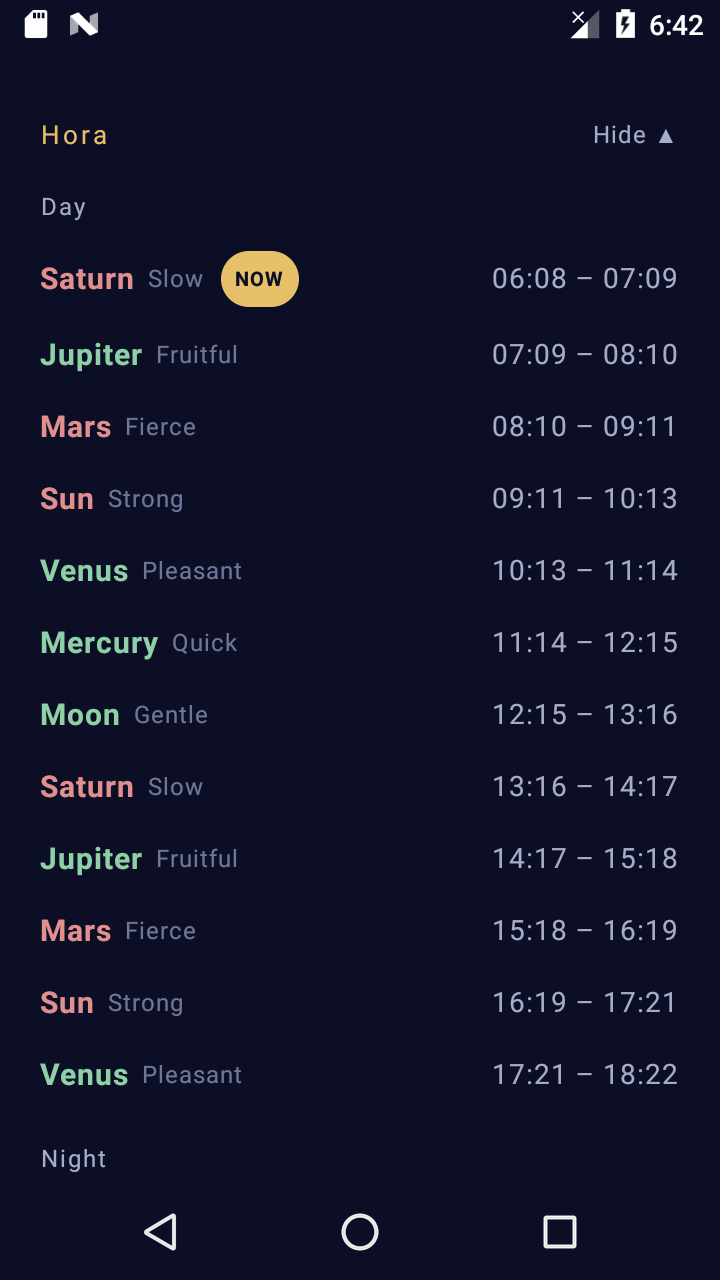
Hora, the planetary hour running now
Which planet rules the hour you are in — Sun, Moon, Mars, Mercury, Jupiter, Venus or Saturn — what that hora is traditionally good for, and when the next one begins. Twelve horas by day and twelve by night, from your city's sunrise and sunset, with the shubh horas of Jupiter, Venus, Mercury and the Moon in green. Checked against a published panchang for four cities: every hora within a minute.
Any date, and the whole month at once
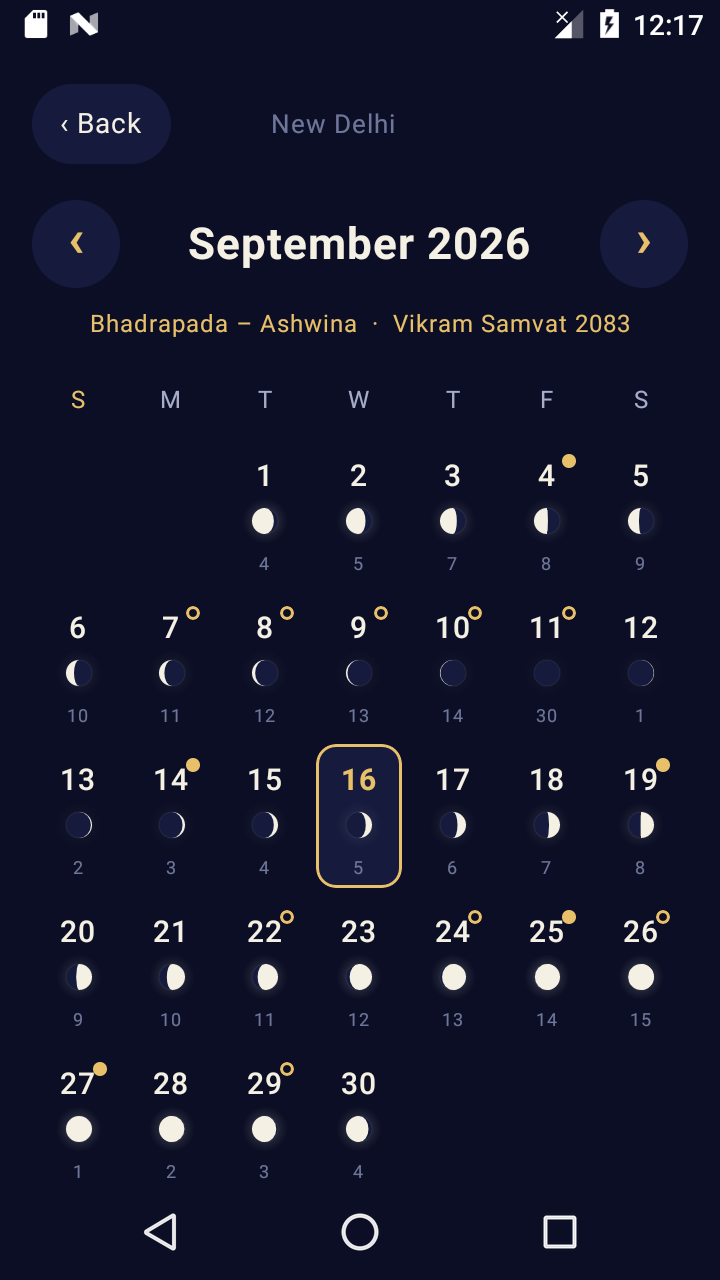
Step back to yesterday or on to tomorrow, or jump straight to a date — a wedding, a journey, a day last year. The calendar draws the Moon for every day of the month, numbers the sunrise tithi and marks festivals and vrats, with the lunar month and Vikram Samvat in the header. Tap a day to open it in full.
Festivals and vrats, on the date the panchang gives them
Diwali, Holi, Maha Shivratri, Janmashtami, Ganesh Chaturthi, Navratri, Dussehra, Karwa Chauth, Raksha Bandhan, Chhath Puja and more — each computed, not looked up in a fixed English table. Every Ekadashi by its own name, plus Purnima, Amavasya, Pradosh, Sankashti Chaturthi and Masik Shivratri. The home screen always carries the next few.
The moon is the reading, not a decoration
A tithi is defined as the Moon gaining 12 degrees on the Sun — so the phase drawn on screen and the tithi named underneath it are the same fact shown two ways. Through Shukla Paksha the moon fills; through Krishna Paksha it empties. You can read the day at a glance without reading a word.
Start and end times, on the first screen
Every tithi carries the time it began and the time it ends — including when it runs past midnight into the next day. Alongside it: nakshatra, yoga, karana, vara, sunrise, sunset, moonrise and moonset for your city, and the lunar month — Purnimanta and Amanta — with Vikram Samvat, Shaka Samvat and the ritu. The five limbs are computed at sunrise, the same convention printed almanacs use, and the app says so rather than leaving you to guess.
Your city, without giving up your location
Panchang depends on sunrise, so it depends on where you are. Chandrika asks you to pick from a built-in list of 44 cities across India and abroad instead of requesting location permission. Your choice stays on your phone. Sun and Moon positions come from standard astronomical algorithms with the Lahiri (Chitrapaksha) ayanamsa — the same one Indian almanacs use.
Privacy-first
Read how we handle your data.